Custom software, built by the people who will run it.
Internal tools, customer portals, SaaS products and APIs. One senior team designs it, builds it, ships it and keeps it running, with no hand-off between "the agency" and "maintenance".
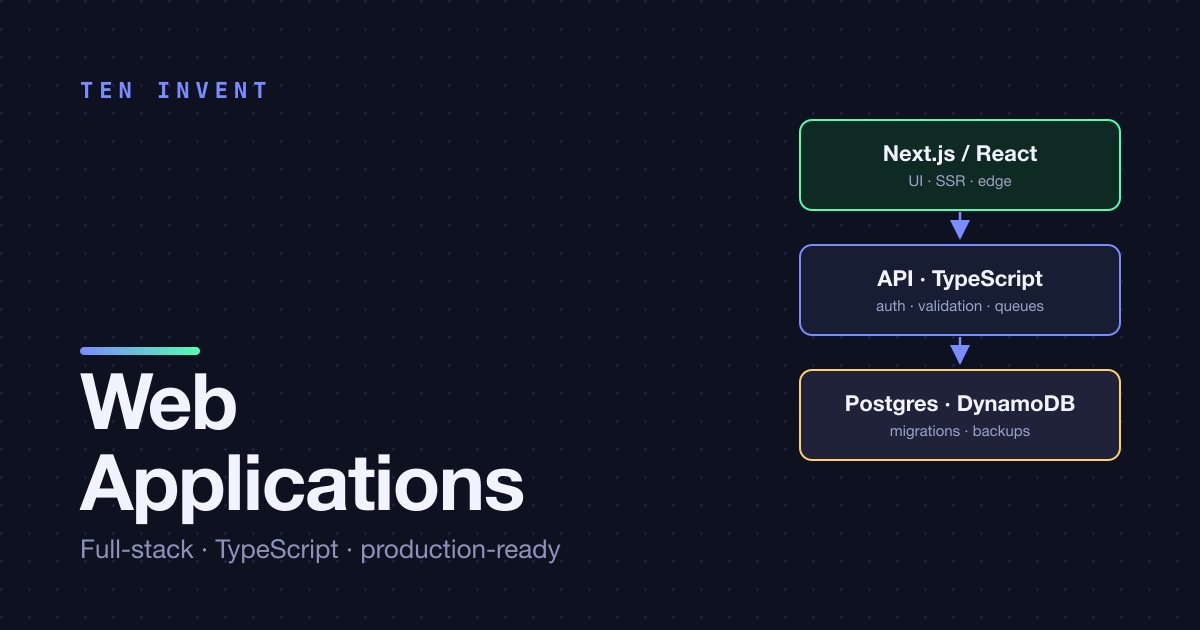
Most custom software fails after launch, not before. It gets built by one team, handed to another, and nobody remembers why the queue worker restarts every night. We avoid that by keeping the same engineers on architecture, code and operations, so the decisions made in week one still make sense in year two.
Our default stack is TypeScript end-to-end: Node.js APIs, React or Next.js frontends, PostgreSQL, deployed as containers on AWS with infrastructure in code. When a project is a better fit for Laravel, we use Laravel. Either way you get typed contracts, automated tests, and a CI/CD pipeline from the first week.
Full-stack, not "front and back".
Product and technical discovery
A short paid discovery turns a vague brief into a scoped backlog, a data model and a first architecture. You can take it anywhere, including elsewhere.
Backend APIs and data
Node.js (NestJS, Fastify) or Laravel APIs, PostgreSQL schemas designed for the next five years, queues, background jobs, webhooks and third-party integrations.
Frontends people actually use
React and Next.js applications with server-side rendering where it matters, accessible components, and a design system that survives the second designer.
Authentication and permissions
SSO, OAuth, roles and tenant isolation done once, correctly, so they never become the thing that blocks a new customer.
Testing and CI/CD
Unit, integration and end-to-end tests that run on every pull request, preview environments for review, and a deploy that is boring.
Deployment and operations
Containers on AWS (ECS, App Runner), infrastructure as code with CDK, monitoring, alerts and a runbook your team can follow at 3 a.m.
What you get
- A working application in your own repositories and cloud accounts, from day one
- Architecture notes and a data model your next engineer can read
- Automated test suite and a CI/CD pipeline with preview environments
- Infrastructure defined in code, with dev, staging and production separated
- Weekly demo, weekly report of hours, and a backlog you can reprioritise any time
This is for you if
- You need an internal tool, portal or SaaS product and want it built right the first time
- Your current vendor ships features but nobody can explain how the system works
- You have a product idea and need a senior team to take it from spec to paying users
How an engagement runs
You get a senior engineer who delivers like a small team — with a transparent hourly rate, weekly reporting, and no agency overhead. Scale hours up or down as the project needs.
- 01Discovery — one to two weeks to define scope, data model, architecture and a realistic first milestone.
- 02Foundation — repositories, environments, CI/CD, auth and the core domain model; a deployable skeleton in the first weeks.
- 03Iterations — weekly increments, each demoed on a preview environment and shipped to production when you say so.
- 04Handover or run — we document, train your team, and either hand over or stay on to operate and extend the system.
Questions we hear before every engagement
TypeScript or Laravel, which one will you use?
Our default is TypeScript end-to-end (Node.js, React/Next.js, PostgreSQL) because one language across the stack keeps a small team fast. We use Laravel when the project is content-heavy, when your team already knows PHP, or when Laravel's batteries (auth, queues, admin tooling) shorten the path. We will tell you which and why before writing code.
How fast can we have something in production?
A deployable skeleton with authentication, CI/CD and environments typically exists within the first two to three weeks. First real feature in users' hands usually follows in the same month. Modern AI-assisted tooling speeds up the routine parts; senior review keeps the quality.
Who owns the code?
You do, from the first commit. Everything lives in your GitHub organisation and your AWS accounts. There is no lock-in and no licence fee.
Can you work with our existing developers?
Yes, and it is often the best setup. We take architecture and the hard parts, pair with your team on the rest, and leave them able to maintain everything without us.
What does it cost?
Hourly, time-and-materials, invoiced monthly by an EU company. There is no fixed-price theatre: you get a realistic estimate per milestone, a weekly hours report, and the freedom to scale up or stop at any point.
How we think about it
How we build web applications: the first three weeks, and the year after
This year we shipped two very different web platforms with the same method. One is a multi-tenant storefront platform fo...
September 2026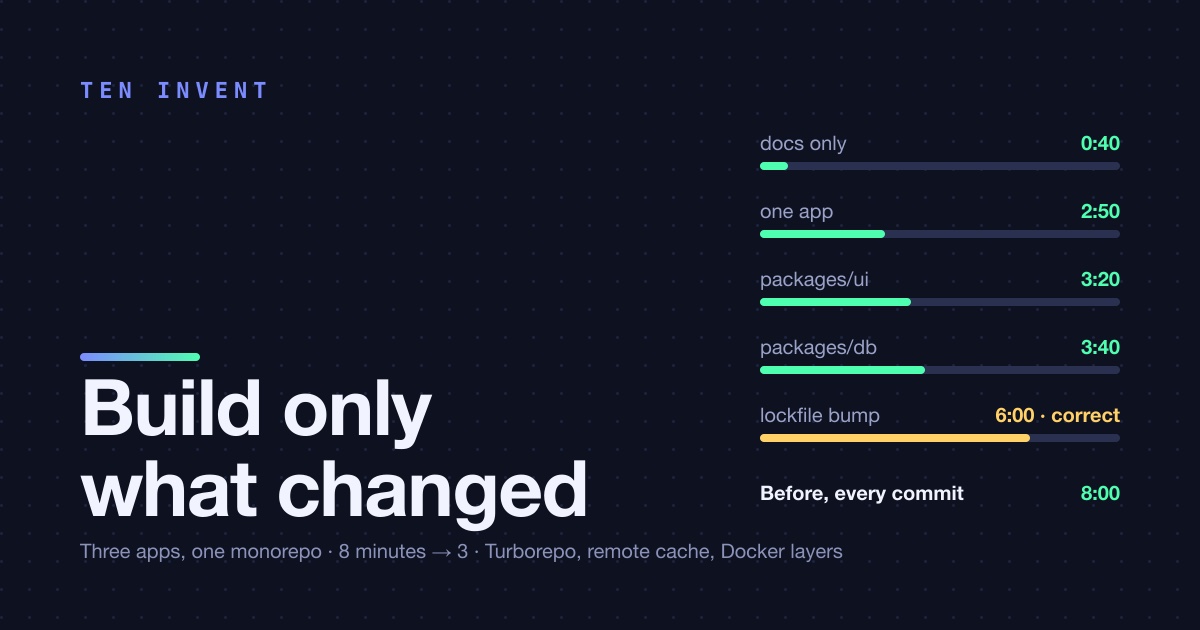
A monorepo with three apps: how we build only what changed, and got the pipeline from eight minutes to three
Three Next.js applications, four shared packages, one repository. That's the shape of the platform we run for a US clien...
September 2026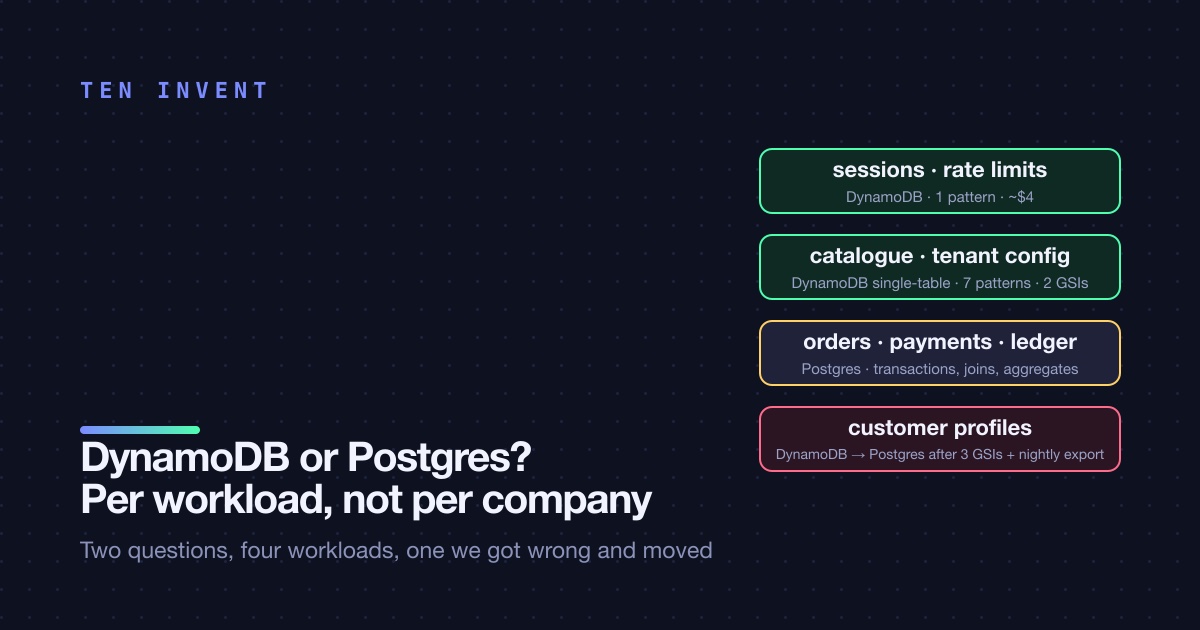
DynamoDB single-table or Postgres? How we chose, per workload, and where we got it wrong
The DynamoDB versus Postgres debate is usually argued as a religion. One side says relational data belongs in a relation...
September 2026Have a product to build?
Flexible hourly / time-and-materials engagements, fully remote, B2B. Direct communication with the engineer doing the work — no hand-offs, no sales pitch.