AI that ships to production, not to a slide deck.
We add language-model capabilities to the software you already run: document processing, assistants, agents that take actions, search that understands questions. Measured, monitored and priced like any other feature.
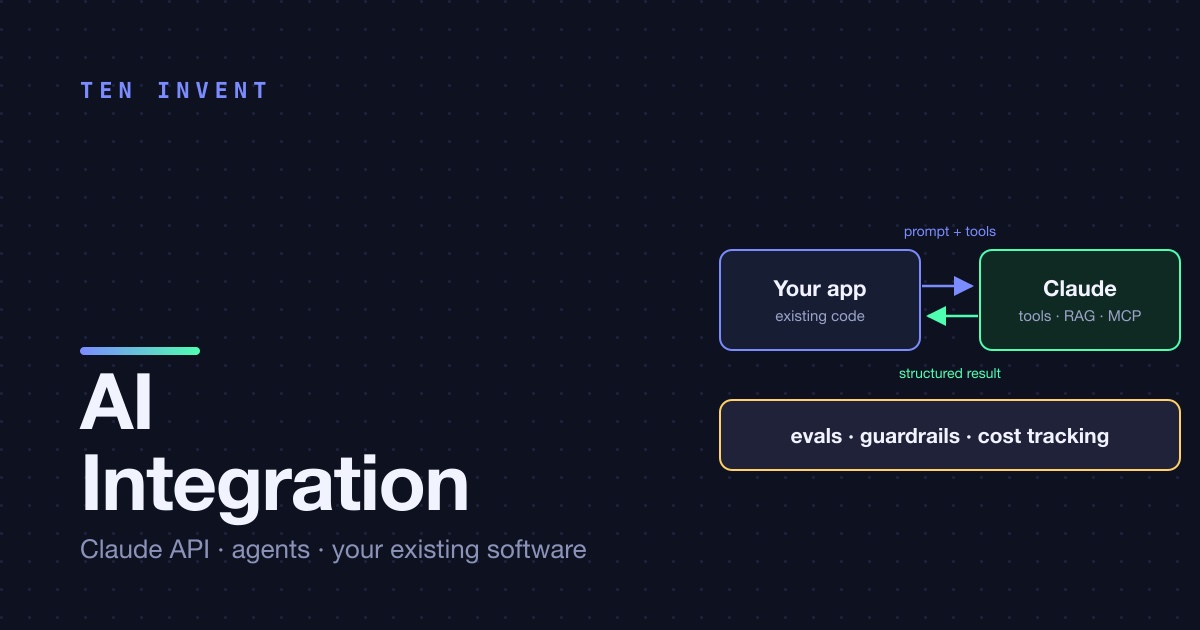
Every company has seen the demo. Fewer have seen the feature survive real users, real documents and a real invoice. The difference is engineering: retrieval that returns the right chunk, prompts under version control, evals that run on every change, and cost and latency that someone actually watches.
We build on Claude via AWS Bedrock or the Anthropic API, with agent frameworks, MCP tool servers and RAG pipelines where they earn their place. We have also run the same workloads on open models when data residency or cost demanded it. Our own products, Bob AI and the Agent Factory platform, run on the same patterns.
From a use case to a monitored feature.
Use-case discovery and feasibility
A short spike on your real data answers the only question that matters: does the model do this reliably enough to be worth building? With numbers, not opinions.
LLM features inside existing products
Summaries, extraction, classification, drafting and Q&A wired into your current backend, with typed outputs your code can trust.
Agents that take actions
Tool-using agents on Bedrock or the Claude API, with MCP servers for your systems, guardrails, human approval steps and an audit trail.
RAG and search over your documents
Ingestion, chunking, embeddings, hybrid search and re-ranking on PostgreSQL/pgvector or OpenSearch, tuned on your corpus, not a benchmark.
Evals, observability and cost control
Golden datasets, automated evals in CI, tracing of every call, token budgets and alerts. You will know when quality drops before your users do.
Private and open models
When data cannot leave your VPC, we run open-weight models on your infrastructure and design for the trade-offs honestly.
What you get
- A feasibility report with measured accuracy, latency and cost on your own data
- Production code in your repository: prompts, tools, pipelines and typed interfaces
- Eval suite and golden dataset that run automatically on every change
- Tracing, dashboards and alerts for quality, latency and spend
- A written model and data policy your legal team can sign off
This is for you if
- You have a repetitive, language-heavy process (documents, tickets, emails, reports) that people are tired of doing by hand
- You built a prototype that impressed the board and now need it to work for customers
- You want an assistant or agent in your product and need it to be safe, measured and affordable
How an engagement runs
You get a senior engineer who delivers like a small team — with a transparent hourly rate, weekly reporting, and no agency overhead. Scale hours up or down as the project needs.
- 01Spike — one to two weeks on real data to measure whether the model does the job and what it costs.
- 02Design — architecture, data flow, guardrails, eval plan and cost model, agreed before the build.
- 03Build — the feature, its tools and pipelines, with evals in CI from the first week and a staged rollout.
- 04Operate — monitoring, prompt and model updates, cost reviews, and the option for us to stay on.
Questions we hear before every engagement
Which models do you use?
Mostly Claude, through AWS Bedrock when you are on AWS or through the Anthropic API otherwise. We pick the smallest model that passes your evals, and we have run open-weight models on private infrastructure when data residency required it. We are not tied to a vendor.
Is our data used to train anything?
No. With Bedrock and the Anthropic API, prompts and outputs are not used for training. We document exactly which data goes where, and for sensitive workloads we keep everything inside your VPC.
How do you know it works?
We build a golden dataset from your real cases early, define what "correct" means with you, and run evals automatically on every change. The numbers decide whether a prompt or model change ships.
What about hallucinations?
We design for them: retrieval with citations, structured outputs validated by code, confidence thresholds with human review, and agents that ask before acting. The goal is a system that fails safely and visibly, not one that pretends to be perfect.
What will it cost to run?
We measure token usage per request during the spike and give you a cost per document, ticket or conversation before you commit. Budgets and alerts are part of the build, not an afterthought.
How we think about it
How we build AI integration: a two-week spike, a golden dataset, and a bill you can predict
Three AI systems we built are in production today. A research assistant for a US client, running on AWS Bedrock with an...
September 2026
Enterprise AI Agents at Scale: What BNY Mellon's 20,000 Agent Deployment Teaches Us All
Something remarkable happened in the financial sector in early 2026. BNY Mellon, the world's largest custody bank managi...
March 2026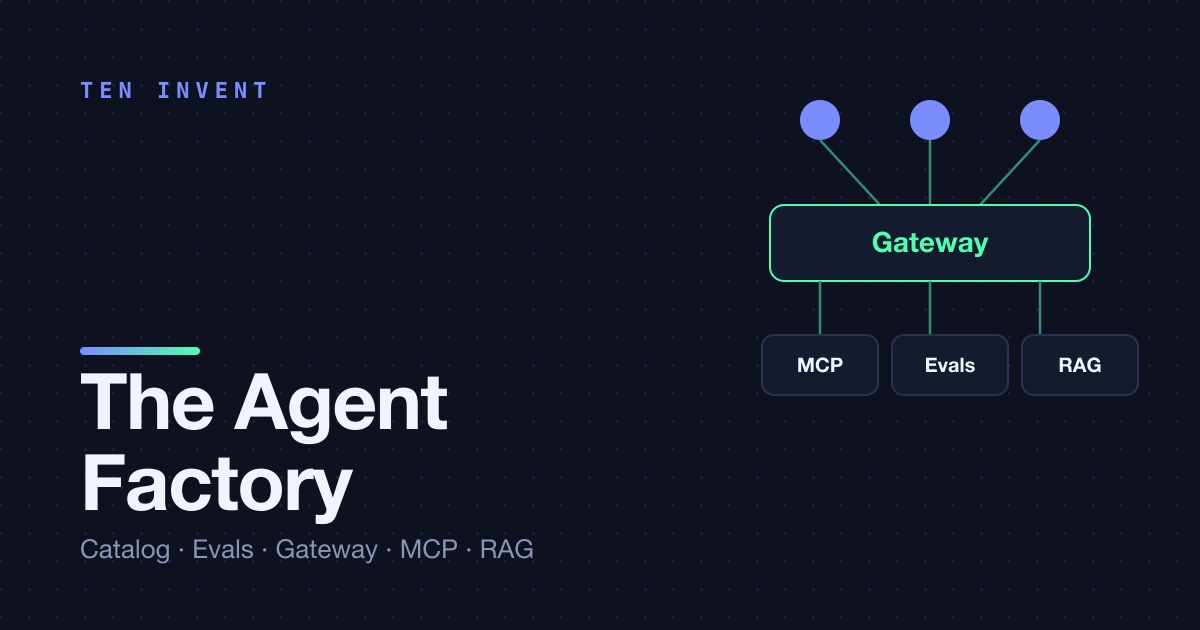
Don't Build an Agent. Build the Agent Factory.
Anyone can build an AI agent in a weekend. A good model, a few tools, a decent system prompt — and you have a demo that...
August 2026Have a process AI should be doing?
Flexible hourly / time-and-materials engagements, fully remote, B2B. Direct communication with the engineer doing the work — no hand-offs, no sales pitch.